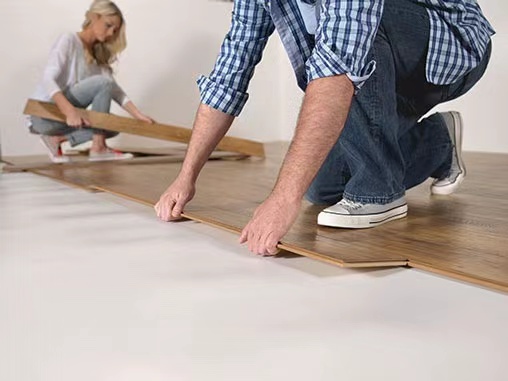
For every flooring merchant in the Australian market, underlay is a compulsory course. The main reason is that apartment strata have expressly agreed terms (By-Law) regarding sound insulation, and specific terms vary from strata to strata and from buildings to buildings.
When doing floor renovation for detached houses, the choice of underlay is not stipulated by the By-Law of the strata or residents committee. The main consideration is the levelling among floor materials. For example, the height difference between the kitchen tile and the plain floor is 20mm, and the board you choose is 12mm, then if you use 2mm underlay, there will be a 6mm height difference. If the height difference is not acceptable, we need to consider using thicker underlay, plywood, or concrete to do levelling.
The situation of a townhouse (Villa) is roughly the same as that of a house. Although villas are under the management of the strata and residents committee, the requirements are relatively loose. Because neighbours are not downstairs and the flooring renovation has little influence on them. Therefore, underlay choice is mainly depending on the preference of the owner and the levelling issue.
For apartments, the situation is different because the acoustic issue has a direct influence on neighbours downstairs, and thus the requirements will be stricter. Before installing the floor, the owner himself, or the flooring company on behalf of the owner, needs to submit an application to strata and provide relevant documents. The most important document is the underlay acoustic test report. In more stringent cases, strata will require owners to conduct acoustic tests. The acoustic tests are divided into pre-installation and post-installation. If pre-installation tests are required and the test results do not meet the standard, then the installation cannot be performed. If the post-installation tests are required and the test results do not meet the standard, you may be required to remove the flooring boards and redo the renovation to fulfil the strata By-law.
Common underlays are as follows:
1. Foil Underlay. Normally, they are silver, 2-3mm thick, moisture-proof but not soundproof, and generally applied to houses and villas.

2. Acoustic Underlay, Normally, they are green or orange, 2-3mm thick, and moisture-proof, with an acoustic rating of AAAC 4-5 stars. This kind of underlay is commonly applied to upstairs of houses and appartments whose strata can accept it.


3. Foam Underlay. They are dark grey, about 6mm thick with an acoustic rating of 4-5 stars, and mainly used for levelling purposes.

4. Rubber Underlay. They are black, sometimes with colourful little spots, and have different specifications, such as 5mm, 6mm, 8mm and 10mm. Their acoustic rating is AAAC 5-6 stars, so if your strata requirements are strict, they may be your only option.

Therefore, for those who live in an apartment in Australia, please communicate with strata before installing the floor and confirm the underlay to be used. Because, usually, flooring company have an extra charge for the latter two kinds of underlay, especially the rubber underlay, sometimes their cost may be more expensive than timber boards.
Simultaneously, without approval from the strata, installers cannot enter your property to do the installation. Otherwise, if someone discovered the installation and reported to strata, the installation may be required to stop and you may have to pay the flooring company for removing what has been installed.
Leave a Reply